

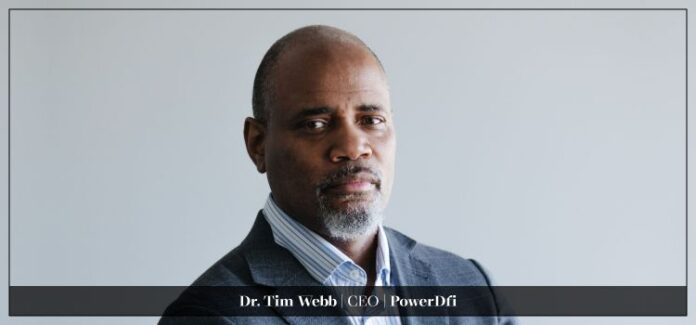

In a world where financial access remains uneven and asset liquidity is still a privilege of the few, a quiet revolution is unfolding—one powered by blockchain, driven by purpose, and designed for inclusion. At the heart of this transformation stands PowerDfi, a company that is radically redefining how individuals, communities, and even entire nations interact with real-world assets (RWAs).
From land in rural Kenya to renewable energy projects in South America, PowerDfi is unlocking dormant wealth by turning physical assets into digital ones—transforming the very nature of ownership, trade, and capital access. It’s a bold vision with global ambition, and it’s anchored in one powerful idea: everyone should have access to the financial tools once reserved for institutions.
From Tangible to Tokenized
“Our goal is to reimagine how people interact with their assets,” says Mr. Tim Webb, CEO at PowerDfi. “With blockchain, we’re allowing landowners, developers, entrepreneurs—anyone—to tokenize their physical and financial assets and make them tradeable on a digital platform.”
This shift from the tangible to the tokenized means assets that were once illiquid and isolated can now be fractionalized, monetized, and integrated into a global marketplace. A farmer’s land, for instance, can be digitized and leased internationally. A renewable energy developer can tokenize their infrastructure and raise capital from global investors. A family heirloom, locked in a vault for generations, can now generate passive income through lending or staking.
“It’s not just innovation for the sake of tech,” they emphasize. “It’s transformation with real-world financial outcomes.”
The implications are far-reaching. Asset owners can unlock liquidity without selling. Communities can access capital without gatekeepers. And wealth creation becomes less about privilege and more about participation.
Levelling the Financial Playing Field
This mission isn’t just about disrupting traditional finance—it’s about rewriting its rules. For PowerDfi, democratization isn’t a buzzword. It’s a business model.
“Financial inequality is one of the most pressing challenges of our time,” Tim explains. “We’re here to level the playing field.”
By leveraging blockchain, PowerDfi eliminates traditional barriers like geography, lack of credit history, and institutional gatekeeping. A property owner in Mississippi, a farmer in Nairobi, or an artisan in Rajasthan can now participate in a decentralized economy on their own terms.
And participation doesn’t just mean investment. It means autonomy. “Digitization gives individuals control,” they add. “It gives them tools they’ve never had before—tools to trade, borrow, lease, and grow wealth independently.”
This is financial inclusion redefined. It’s no longer about access to a bank—it’s about access to an ecosystem.
The Digital Barter Revolution
Central to PowerDfi’s offering is its Electronic Barter System (EBS)—a pioneering platform that allows users to buy, sell, lease, lend, or borrow both physical and digital assets. All interactions are conducted through tokenized representations of these assets, with every transaction secured by smart contracts.
Imagine a world where an art collector in Amsterdam lends a sculpture to a gallery in Cape Town, while simultaneously leasing land in Colombia and borrowing against a digital currency portfolio—all from a single dashboard. That’s the future EBS is enabling.
“Bartering has been around forever,” Tim says. “We’re just rebuilding it for the blockchain era.”
The advantages are substantial. No intermediaries. No complex paperwork. Full transparency. And total flexibility. Users can engage in fractional ownership, time-based leases, or conditional trades—all within a secure, trustless environment.
It’s not just efficient. It’s elegant. And it’s changing how value flows in the global economy.
Smart Expansion, Smarter Retrenchment
In 2022, PowerDfi made headlines with its acquisition of Naijacrypto, a prominent cryptocurrency exchange in Nigeria. The move signaled the company’s intent to expand rapidly into emerging markets. But when regulatory uncertainty and market volatility loomed large—especially after the collapse of FTX—PowerDfi made a strategic retreat.
“It was a difficult decision, but the right one,” Tim shares. “We want to grow smart—not fast.”
Despite that step back, the vision for global expansion remains bold. The focus has now shifted toward cross-border payments and stablecoin infrastructure—two sectors with the potential to deliver massive financial impact.
“We’re building tools that will serve both institutional giants and underserved communities. Our ambition is to redefine value exchange for everyone—securely, efficiently, and equitably.”
It’s a recalibration, not a retreat—and one that speaks to the company’s long-term resilience and strategic foresight.
Fortress-Level Security
In a landscape increasingly fraught with cyber threats, PowerDfi knows that trust must be earned—layer by encrypted layer.
“Our platform is built like a fortress,” the team says. “Security isn’t just a feature—it’s our foundation.”
At the core is the Power Vault, a secure asset repository powered by enterprise-grade encryption, multi-factor authentication, and decentralized storage protocols. Smart contract audits are conducted continuously, and fraud detection systems operate around the clock.
Blockchain offers transparency, but PowerDfi goes several steps further. “We don’t just rely on the technology. We build security into every layer of our stack. Because our users aren’t just trusting us with data—they’re trusting us with their future.”
It’s a philosophy that blends innovation with integrity—and one that underpins every line of code.
Making Tokenization Frictionless
Tokenization may sound complex, but PowerDfi has made it intuitive and accessible. The platform offers free tokenization for assets under $100,000 and nominal fees for larger assets. More importantly, it incentivizes users to store their digitized assets in the Power Vault, rewarding them with PDFI tokens on a monthly basis.
“Participation should be easy and rewarding,” Tim says. “That’s how you build real engagement and liquidity.”
These tokens, in turn, can be used for loans, trades, or staking—creating a circular economy where value is constantly flowing, compounding, and evolving.
It’s a model that doesn’t just digitize wealth—it accelerates it.
A Vision as Vast as the Globe
So what’s next for a company already pushing the boundaries of what’s possible?
“Trillions in real-world assets remain untapped,” Tim explains. “Our goal is to bring them online—especially in underbanked regions.”
But the ambition doesn’t stop at tokenization. PowerDfi is developing structured finance tools that allow users to hedge currency risk, create derivatives, and participate in advanced financial strategies—all through an accessible, user-friendly interface.
“We want to make Wall Street tools available on main street,” they say. “This is the future of capital—borderless, inclusive, and intelligent.”
It’s a future where a single platform can unlock liquidity for a village, hedge risks for a developer, and create generational wealth for a family. It’s not just about digitizing assets. It’s about democratizing opportunity.
Leading with Purpose
In an industry often driven by hype and speculation, PowerDfi stands out for its clarity of purpose. Its innovation is never detached from real-world impact. Its technology is never separate from its social mission.
“We’re not building tools just for the sake of being ‘techy,’” Tim concludes. “We’re building an ecosystem where value can be created and shared—fairly, securely, and globally.”
From a single farm in Kenya to a multinational developer in Brazil, PowerDfi is offering something rare: agency. And in doing so, it’s not just changing how assets are managed. It’s changing what’s possible.