

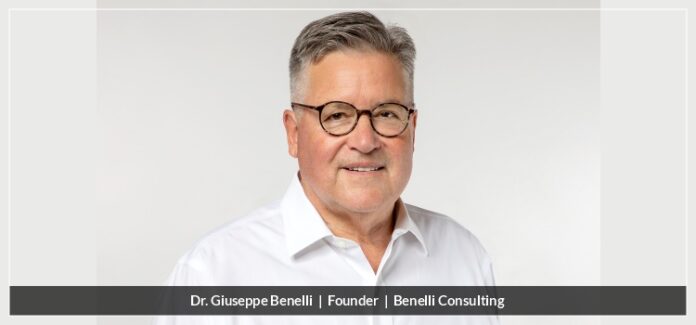

Dr. Giuseppe Benelli is the founder of Benelli Consulting an independent advisory firm providing strategic investment advice to banks, insurance companies, and institutional investors.
Over a distinguished career spanning more than three decades in global finance, he has held some of the industry’s most senior investment positions, including Chief Investment Officer and Member of the Executive Board at Swiss Re, as well as Chief Investment Officer at Vontobel Asset Management.
Earlier in his career, he served as Chief Investment Officer at Bank Leu, where he led financial analysis and portfolio management. Dr. Benelli holds a PhD in Economics from the University of Bern and continues to contribute his expertise through advisory and board roles in the international financial sector.
- What is Benelli Consulting’s founding vision, and how does your firm position itself within rapidly evolving financial markets?
Through our services, we provide independent advice to banks, insurance companies, family offices, trusts, pension funds, and other financial institutions. Our expertise includes asset management, investment decision-making processes, risk management, product evaluation, and investment optimization.
We also manage consulting projects related to organizational challenges, restructuring, acquisitions, and process optimization, including interfaces with back-office and reporting solutions.
Based on various quantitative models, we offer optimization and monitoring of investment processes. Thanks to the expertise of our partners in banking and insurance, we support clients in risk management and the development of shared service center resources.
Additionally, our experience in process management enables us to help clients retain existing customers while also developing new customer relationships.
- What differentiates Benelli Consulting in supporting financial investors in improving their investment decision-making and asset management processes?
Through strong partnerships with independent experts in the banking and insurance sectors, Benelli Consulting offers a broad range of services that many traditional consultancies cannot provide. These include asset and wealth management advisory, corporate strategy, fintech insights, qualitative market analysis, back-office operations, insurance strategies, and insurance-linked securities (ILS).
What truly differentiates Benelli Consulting is its interdisciplinary expertise, international perspective, and operational experience. As an independent platform, the firm focuses on delivering objective advice and practical solutions that serve the long-term interests of its clients.
- How is Benelli Consulting adapting its advisory services to increasing regulatory pressure and the ongoing transformation of the global financial sector?
The financial sector is undergoing a period of significant transformation and uncertainty. Increasing regulatory pressure, growing demands for transparency, and evolving expectations around risk management, incentive structures, and client service are reshaping the industry.
While these developments present challenges, they also create opportunities for those who adapt strategically. At the same time, innovations in alternative investments and the convergence of capital and insurance markets are opening new perspectives for asset management.
Benelli Consulting responds by providing independent, forward-looking advice, helping clients strengthen risk management, enhance transparency, and identify new strategic opportunities in an evolving financial landscape.
- Who are Benelli Consulting’s primary clients in Switzerland, and how does the firm tailor its advisory services to meet their needs?
Our primary clients are institutional investors, including banks, insurance companies, family offices, and pension funds, as well as a select group of private clients who value independent and specialized expertise.
By working closely with an international network of partners, Benelli Consulting delivers interdisciplinary advisory services that combine strategic insight with operational expertise and practical industry experience.
Our independence is a key differentiator, enabling us to act solely in our clients’ best interests and provide objective, forward-looking solutions tailored to a multilingual and internationally oriented client base.
- Which key market trends are currently shaping your advisory focus at Benelli Consulting?
In addition to traditional investments such as equities and bonds, we are increasingly focusing on alternative asset classes, including hedge funds, private equity, real estate, and insurance-linked securities (ILS).
In today’s market environment, institutional investors are seeking broader diversification and more resilient sources of return. Alternative and less liquid investments can offer attractive long-term return potential while improving portfolio diversification.
Benelli Consulting supports clients in identifying and evaluating these opportunities and integrating them strategically into their investment portfolios.
- Looking ahead over the next five years, what are the main risks and structural challenges facing global financial markets, and how could they affect investors and advisory firms such as Benelli Consulting?
One of the biggest challenges will be managing the growing risks in global financial markets, particularly the investment implications of rapidly rising public debt levels. A key question is who will ultimately bear the cost of this expansion.
At the core lies the risk of currency devaluation. Many countries—especially in the United States and Europe—are experiencing rising debt levels with limited signs of improvement. As debt continues to grow, refinancing may become increasingly difficult.
There is also concern that central banks could gradually lose independence, as monetary policy may increasingly be used to finance government debt through low interest rates and liquidity injections.
Such developments could lead to higher inflation, rising long-term interest rates, and increasing refinancing costs. In extreme scenarios, this could destabilize financial markets and potentially lead to debt restructuring.
The only sustainable alternative is strong economic growth that outpaces debt expansion. In this regard, the United States may currently be better positioned than Europe due to its entrepreneurial environment and technological innovation, although tariffs and restrictive migration policies could limit this growth potential.