

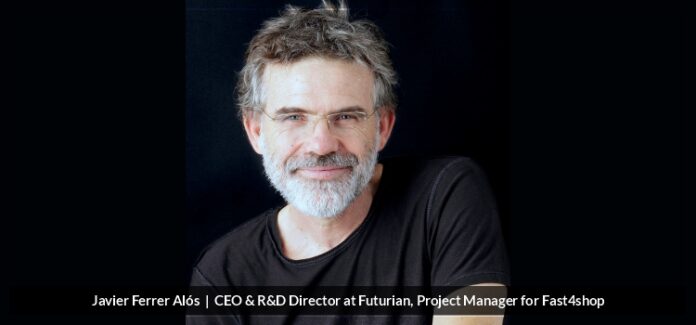

A conversation with Javier Ferrer Alós, CEO & R&D Director, and the R&D Project Manager at Futurian
In the post-pandemic retail landscape—where biosecurity, operational precision, and margin protection intersect—Futurian’s Fast4shop platform has emerged as a decisive benchmark. Recognised as the Top RFID Contactless Self-Checkout Platform for Aseptic Retail 2026, the system defines a new paradigm: Aseptic Retail—a clinically grounded, technologically deterministic model for pharmacy environments.
At the centre of this transformation is Javier Ferrer Alós—pharmacist, systems architect, R&D project manager, and inventor holding five international patents. His work under Futurian has culminated in a transactional ecosystem now operationally validated across European and American markets.
The Fast4shop system (https://fast4shop.com/) exemplifies this convergence of engineering precision and healthcare compliance, while Futurian’s broader R&D philosophy (https://futurian.es/) and the Aseptic Retail framework (https://asepticretail.com/) together define the strategic direction of the company.
Q1. Traditional ERP systems still dominate pharmaceutical retail. Why does Futurian consider them structurally deficient?
Javier Ferrer Alós:
The deficiency is ontological. Barcode systems—EAN-13—operate at the level of product typology, not unitary identity. This creates structural blindness: inventory inaccuracies, administrative errors, expiry mismanagement, and undetected stockouts.
From a financial standpoint, this leads to distorted fixed assets and hidden operational costs. In omnichannel environments, these inefficiencies intensify.
Fast4shop eliminates this vulnerability by injecting RFID serialisation—UHF EPC Class1 Gen2—assigning each unit a unique digital identity. Inventory control becomes physical rather than administrative. We achieve near-100% accuracy, audit thousands of SKUs in minutes during live operations, and eliminate stockouts.
Critically, our automated alert system enforces FEFO (First Expired, First Out), pre-empting expiry and ensuring optimal shelf rotation. The result is a transformation of logistical uncertainty into auditable profitability.
Q2. Queue-induced customer leakage is a known issue in pharmacies. How does Fast4shop address this?
R&D Project Manager:
Queues are structurally incompatible with high-margin front-of-store products. Every minute of friction erodes impulse purchasing and customer loyalty.
Fast4shop introduces transactional hyper-acceleration through the sector’s first contactless, touchscreen-free, unattended self-checkout. Customers place items into the receptacle, and through instantaneous volumetric reading—without scanning—the entire transaction is completed in under 15 seconds.
This model, validated at the Juan Vindel pharmacy in Madrid, eliminates adoption barriers and guarantees absolute privacy—particularly for sensitive purchases such as pregnancy tests or condoms. The system automatically issues a digital receipt, ensuring a seamless, discreet experience.
By removing friction, we eliminate basket abandonment and directly protect the pharmacy’s most profitable revenue stream.
Q3. You’ve described AI-driven retail models as a “mirage.” What underpins this position?
Javier Ferrer Alós:
The financial and operational analysis is unequivocal. Visual AI systems—such as “Just Walk Out”—are not fully autonomous. They require human intervention to validate unresolved transactions, often via offshore labour. This introduces inefficiencies and an unassumable CAPEX for most retailers.
Technically, AI suffers from systematic visual occlusion, particularly with small-volume products common in parapharmacy. More critically, it lacks real-time theft deterrence capabilities.
Fast4shop is built on deterministic engineering. Our system executes a parallel-processing algorithm across two microprocessors, integrating four real-time technological layers:
- Infrared sensors (870 nm) for high-precision gestural detection
- UHF RFID for unit-level traceability
- EAS detection (AM 58 KHz and RF 8.2 MHz)
- A proprietary additional layer ensuring transactional integrity
Unlike probabilistic AI, this architecture guarantees certainty. RFID validation and simultaneous EAS deactivation occur within the same fraction of a second as payment—ensuring both frictionless operation and robust loss prevention.
Q4. You reference empirical data regarding shrinkage. How does this inform your architecture?
R&D Project Manager:
Empirical rigour is central. The NIQ Retail Theft Barometer clearly indicates that traditional self-checkout increases inventory vulnerability.
From a behavioural standpoint, conventional SCO distorts the tacit social contract. Users perceive friction and vulnerability in the system, which psychologically enables opportunistic behaviour—what the industry terms “swipers.”
Addressing this requires more than detection—it requires deterrence by design.
Fast4shop eliminates this behavioural loophole through architectural inevitability. By synchronising RFID identification with native EAS deactivation and sensor-based intent detection, we remove any exploitable gap between action and consequence. The system inherently enforces honest behaviour.
Q5. What defines the ‘Aseptic Retail’ paradigm?
Javier Ferrer Alós:
It is grounded in clinical necessity. Scientific studies—such as those supported by the Royal Society—confirm that touchscreens act as fomites, transmitting pathogens including influenza viruses and Staphylococcus aureus.
In a pharmacy environment, this is unacceptable. Fast4shop eliminates touch interfaces entirely, replacing them with gestural interaction via infrared sensors.
This is not a marketing adaptation—it is a biosecurity standard. On a macroeconomic level, reducing transmission vectors lowers infection rates, decreases healthcare expenditure, and strengthens public confidence in self-service systems.
Q6. Why is RFID alone insufficient for theft prevention?
R&D Project Manager:
RFID is fundamentally a traceability technology, not a standalone anti-theft solution. It is vulnerable to electromagnetic shielding techniques, such as booster bags.
Our solution is synergistic integration. Fast4shop combines RFID with automatic EAS deactivation (AM and RF) and an internal sensor layer that analyses product interaction behaviour.
Only when all conditions align—RFID validation, EAS compliance, and behavioural confirmation—is the transaction authorised. This multi-layered approach eradicates any window of opportunity for theft.
Q7. Does this level of automation risk dehumanising pharmacy services?
Javier Ferrer Alós:
Quite the opposite. Our philosophy is: “The counter for those who need it.”
By automating front-of-store transactions, we decongest the pharmacy and allow healthcare professionals to focus on clinical advisory roles. This elevates human capital from transactional labour to strategic healthcare delivery.
The result is improved patient care and increased profitability.
Q8. How do you ensure regulatory compliance for prescription medicines?
R&D Project Manager:
Through strict segregation. Prescription medicines require human intervention and are processed via 2D codes—QR or DataMatrix—at the counter.
Fast4shop exclusively manages non-prescription products via RFID. However, we also enhance counter operations by enabling RFID-based processing of these items within the POS system.
This mirrors the operational models of global leaders such as Inditex and Decathlon, where RFID replaces barcodes for unit-level control. The result is enhanced traceability, expiry management, and data intelligence—without compromising regulatory compliance.
Q9. Interoperability is often a challenge. How does your system address this?
Javier Ferrer Alós:
Our Universal Integrator (UI-ERP-f4s) operates on a hybrid architecture with maximum decoupling.
- REST API for real-time transactions (payments, loyalty)
- sFTP or API for synchronisation (pricing, VAT, RFID tag generation)
We inject transactional data into ERP systems while unlocking advanced variables native to RFID: expirationDate, expirationMonths, and orderNum.
Our infrastructure supports both On-Premise and Cloud deployments, ensuring flexibility across enterprise environments. Resilience is ensured through data queuing, automatic retries, and periodic backups.
Importantly, we do not store personal customer data—only the minimum required for transaction execution.
Q10. What underpins Futurian’s long-term technological leadership?
R&D Project Manager:
While Futurian was founded in 2021, our leadership team brings over 30 years of industrial and pharmaceutical expertise.
Our commitment to R&D&I is absolute. Following three years of intensive development, we achieved unanimous validation across European and American markets from 2024 onwards.
Our roadmap includes the imminent launch of a new RFID security layer, designed to eliminate residual vulnerabilities and further consolidate our technological leadership.
Q11. What is your roadmap for scaling beyond pharmacy retail?
Javier Ferrer Alós:
Our expansion follows a structured technological cadence:
- ‘Frame f4s’ for logistics and order picking
- ‘Shopping Basket f4s’ for assisted retail
- ‘Shopping Cart f4s’ for mass retail
The final stage introduces a fully autonomous, scan-free shopping trolley with a capacity of 180–210 litres.
This evolution aligns with anticipated cost reductions in RFID, driven by innovations such as graphene-based conductive inks and chipless RFID.
Historically, Walmart attempted to forecast this shift in 2003 but encountered the peak of inflated expectations on the Gartner Hype Cycle. The difference today is technological maturity.
Our patented sensor-based heuristics provide the missing layer required to realise this vision—eliminating queues entirely in large-scale retail environments.
Conclusion
Fast4shop represents a deterministic re-engineering of retail infrastructure—where biosecurity, financial precision, and technological certainty converge.
By anchoring its architecture in patented innovation, empirical validation, and behavioural science, Futurian has not only solved the inefficiencies of traditional self-checkout but has established a new operational doctrine for modern retail.
Aseptic Retail is no longer a conceptual framework—it is a deployed, scalable reality.
Corporate Information
Company Name: Futurian S.L.
Headquarters: Calle Trasagrario, 4 – Apdo. 28; 46111 Rocafort, Valencia (Spain)
Factory Location: Parque Tecnológico; Calle Sir Alexander Fleming, 11 derecha; 46980 Paterna, Valencia (Spain)
Websites: https://fast4shop.com | https://futurian.es | https://asepticretail.com
Contact: contact@fast4shop.com | Tel: +34 618 486 241