


It Started at a Kitchen Table
In 2012, the foundations of Infinity Group Australia were laid not in a corporate boardroom, but at a kitchen table in Port Macquarie, New South Wales.
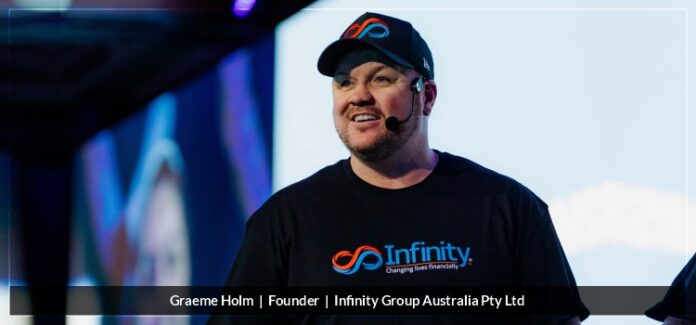
Graeme Holm had spent almost a decade inside one of Australia’s major banks. What he saw there convinced him that something fundamental was missing from the financial-services model. Customers could secure a mortgage, receive their paperwork and walk away with a 30-year financial obligation—but often without anyone staying alongside them to help manage it.
For Holm, the problem was not a shortage of financial products. It was a shortage of ongoing guidance.
He and his wife, Rebecca Holm, set out to build something different: a financial-services business designed around the person rather than the product.
The idea was simple: Australians did not need another lender. They needed a coach.
From Mortgage Broker to Financial Coach
Holm’s experience across more than two decades in financial services, real estate, development and project marketing shaped Infinity’s model.
He had seen firsthand how financial decisions that appear separate are often deeply interconnected. A mortgage affects household cash flow. Cash flow affects debt repayment. Debt affects the timing of property investment. Property decisions, in turn, influence long-term wealth creation.
Yet consumers frequently navigate these decisions through a collection of disconnected professionals.
Infinity was designed to bring those pieces together.
Each household receives a Finance Strategist, Wealth Strategist and Relationship Manager, creating a coordinated team around the client’s financial circumstances. Instead of treating a mortgage as an isolated transaction, the company continually reviews how the financing structure, household budget, property strategy and broader wealth plan fit together.
The First Proof Came Quickly
The market response was immediate.
By the end of Infinity’s first year, the company had more than 250 clients and had opened an office in Bella Vista, Sydney. For Holm, that early traction demonstrated that the gap he had identified was not merely theoretical.
Growth followed office by office rather than through acquisition. Today, Infinity operates across four states, with locations in Southport on the Gold Coast, Norwest and Wollongong in New South Wales, and Cremorne in Victoria.
The numbers tell the story of that expansion. The business has settled more than AUD 3.359 billion in loans and AUD 4.031 billion in real estate transactions. In 2026, MPA ranked Infinity as Australia’s No. 2 brokerage, up from No. 4 the previous year. The company was also recognised as the Best Financial Services Employer in Australia in The Australian’s Best Places to Work 2026.
But scale has not fundamentally altered the company’s original proposition.
Turning a 30-Year Mortgage Into a Long-Term Strategy
Infinity’s approach rests on three levers: structure, cash-flow discipline and sequencing.
The first is about making the underlying loan configuration work as efficiently as possible. The second involves building and monitoring a realistic household budget with the client. The third is about deciding when to shift from aggressive debt reduction toward asset acquisition.
The logic is deliberately methodical.
Move too quickly into asset acquisition, and progress on debt can be undone. Wait too long, and opportunities for compounding may be lost. By continually reviewing these decisions rather than revisiting them only at settlement, Infinity aims to turn a conventional 30-year mortgage into a substantially shorter debt journey while simultaneously building a portfolio.
According to Holm, some clients have become mortgage-free in seven to ten years and saved hundreds of thousands of dollars in interest—not through a “magic rate,” but through sustained oversight and behavioural discipline.
That last point is central to the company’s philosophy.
The Behavioural Problem Behind the Financial One
Australians today have access to more financial information than ever. Yet information alone does not necessarily produce better financial behaviour.
Infinity’s diagnosis is that households are not necessarily short of information; they are short of a plan and someone to hold them accountable to it.
This is where the company’s “personal trainer for finances” analogy becomes more than a marketing line.
A personal trainer does not simply hand over a workout plan. They return, measure progress, adjust the program and keep the individual accountable. Infinity applies the same principle to money through regular reviews, budgeting and structured accountability conversations.
The model recognises a reality that many financial strategies underestimate: execution is often harder than advice.
That insight also explains why the company has invested in financial education beyond its paying clients. The Money Mentor Podcast, webinars, masterclasses, live REM events and social channels are designed to make financial education accessible even to Australians who never become Infinity customers.
Reputation Is Built After the Sale
For Infinity, reputation is not presented as a communications exercise. It is a consequence of what happens after the transaction.
The company’s stated hierarchy is revealing: care, honesty and results—in that order.
Holm argues that Infinity should be measured not by how much debt it writes, but by whether its clients ultimately become less burdened by debt.
That philosophy influences everything from hiring and compensation to the way the company communicates with customers.
It also extends beyond the customer base. Infinity has been Kmart’s No. 1 corporate partner of the Wishing Tree Appeal across Australia and New Zealand and supports housing for families escaping domestic and family violence.
For a business operating in a sector where trust is foundational, the distinction matters. A mortgage is not simply another financial product. It can represent decades of a family’s income, security and future.
Scaling Culture Without Losing the Relationship
The challenge for any founder-led organisation is maintaining the intimacy that helped create its reputation once the organisation becomes significantly larger.
Infinity has attempted to solve that structurally.
Graeme Holm retains responsibility for strategy and education, while Rebecca Holm focuses on operational excellence, client care and culture. The Relationship Manager role remains embedded in the client model, ensuring that someone continues to monitor progress, recognise wins and address problems when a financial plan starts to drift.
The company applies the same coaching philosophy internally, with capability-linked pay and career pathways.
The result is reflected in the company’s reported employee feedback: 97% of its team rated their experience as good or excellent in early 2026. Infinity also reports a 5.0-star rating across more than 1,395 Google reviews.
The Next Chapter: Two Voices, One Philosophy
Infinity’s next challenge is not simply geographic expansion. It is determining how far its philosophy can travel without remaining dependent on one person.
For years, the Money Mentor brand has been closely associated with Holm. Now, Rachael Howlett—a multi-award-winning Finance Strategist and RateMyAgent Broker of the Year—is joining him as a second Money Mentor voice.
The rationale is straightforward. Different audiences respond to different perspectives, and financial freedom is not a one-size-fits-all proposition.
At the same time, Infinity is investing in technology that will give clients live visibility into their financial progress while expanding its free financial-education program.
The evolution is notable because the company is not positioning technology as a replacement for human accountability. Instead, it is being used to make progress more visible and the relationship more informed.
From Transaction to Relationship
The story of Infinity Group is ultimately a story about changing the unit of value in financial services.
The traditional model begins and ends with the transaction. Infinity’s model begins with the transaction and asks what happens next.
That shift—from mortgage broker to long-term financial coach—has allowed a business that began at a Port Macquarie kitchen table to become a national organisation handling billions of dollars in loans and real estate transactions.
Its proposition is simple, but strategically demanding: help customers make better decisions, stay engaged long after the transaction, and measure success by the financial outcome rather than the sale itself.
For Infinity Group, that is more than a service model. It is the foundation on which the company has built its growth, culture and reputation.